




Lowest Spreads and Flexible Terms.




Wages are growing at the slowest pace in 5 years, and employment in Poland is falling
Wages are rising more slowly, employment is still falling
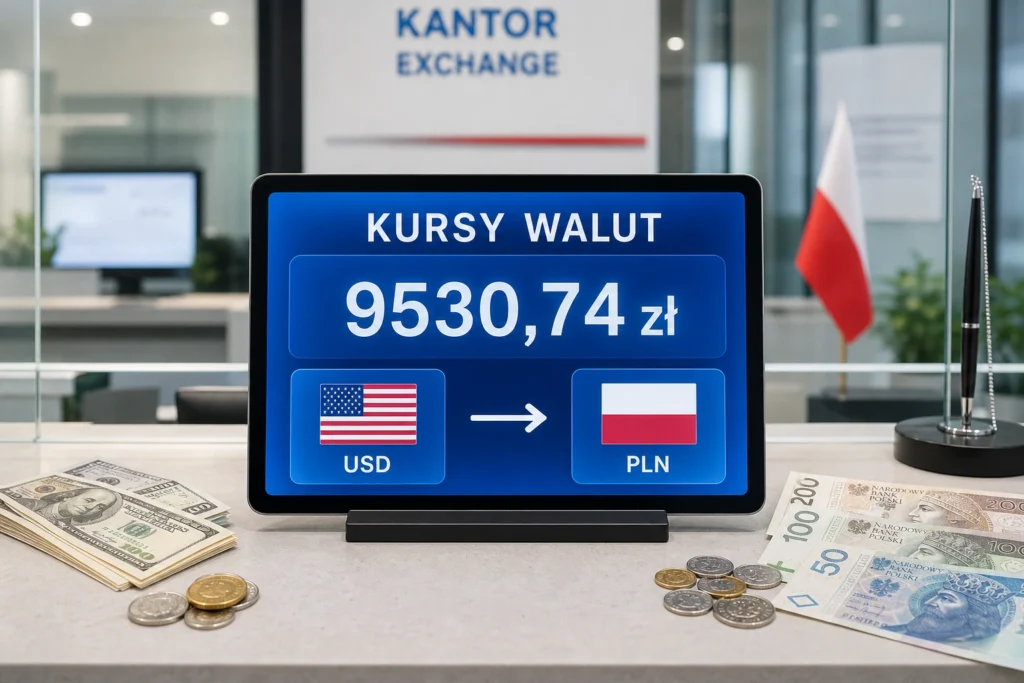
April labor market data showed that wage pressure in large companies is easing. Average pay in the enterprise sector came in at 9530,74 zł gross in April 2026 and was 5,4% higher than a year earlier. That is the slowest pace of growth since February 2021.
On a month-on-month basis, the national average fell by 1,3%, after rising by 5,7% a month earlier. That reflects the fact that March usually brings annual bonuses, awards and other extra payments. There were fewer such components in April, or none at all.
For workers, this is a less favorable reading, but from the economy’s perspective it points to weaker pressure on prices. With CPI (Consumer Price Index) inflation estimated at 3,2%, real wage growth came in at 2,10% y/y. That is the lowest reading since September 2023.
Slower wage growth may also delay talk about interest rate hikes at the NBP (Narodowy Bank Polski, the National Bank of Poland). For people exchanging money, the key point is that slower wage growth usually means less pressure to push up costs quickly across the economy.
Employment at companies is still weakening
The Central Statistical Office also said that average employment in the enterprise sector stood at 6386,4 thousand people in April. That is 11,6 thousand fewer than in March and 0,9% down from a year earlier.
The drop in employment is not a one-off. Last year, the number of jobs in the enterprise sector fell by 43,4 thousand, and in 2024 by 41,6 thousand. After four months of 2026, the balance stands at -23,9 thousand.
This shows that caution remains on the part of companies in the labor market. For some households, it means employers are less willing to raise pay, while for people earning in foreign currencies it means paying closer attention to how much is actually left after converting into złoty.
Why these data matter for the złoty
The labor market still is not showing a return to the very rapid wage growth seen in 2022-24. Back then, pay was rising at double-digit rates, while today the pace is clearly lower. That matters especially when new inflationary factors appear, including tensions in the Middle East.
If price pressure does not accelerate more strongly, the NBP may stay cautious in the coming months. For the złoty, that usually means fewer sharp moves, but also greater dependence on inflation data and global market sentiment.
In practice, the key takeaway for kantor.exchange readers is that April data do not show a return to strong wage growth. Instead, they point to further cooling and weaker demand for labor in large companies.
Sources