




Lowest Spreads and Flexible Terms.




Tensions in the Middle East are rising, but the złoty remains stable against the euro and the dollar
The zloty stays calm despite tensions around the Persian Gulf
Following an overnight escalation of tensions around the Persian Gulf, financial markets reacted nervously and oil prices rose. In Poland’s currency market, however, the move was limited, and EUR/PLN in the morning was still close to Wednesday evening’s level.
In the night from Wednesday to Thursday, several vessels, including a U.S. tanker, tried to sail through the Strait of Hormuz despite Iran’s opposition. There was an exchange of fire, a U.S. airstrike on targets near Bandar Abbas, and an Iranian attack on a U.S. base in the Persian Gulf region.
This sequence of events does not reduce the risk of further escalation and does not bring a lasting reopening of the Strait of Hormuz any closer. For now, markets are paying more attention to commodity prices than to the latest political statements.
Brent crude initially gained several percent, but by 9:13 it was up only 2.5% and was trading at less than 95 USD per barrel. This also matters for the zloty, as since the beginning of March, EUR/PLN quotes have shown a clear correlation with oil prices.
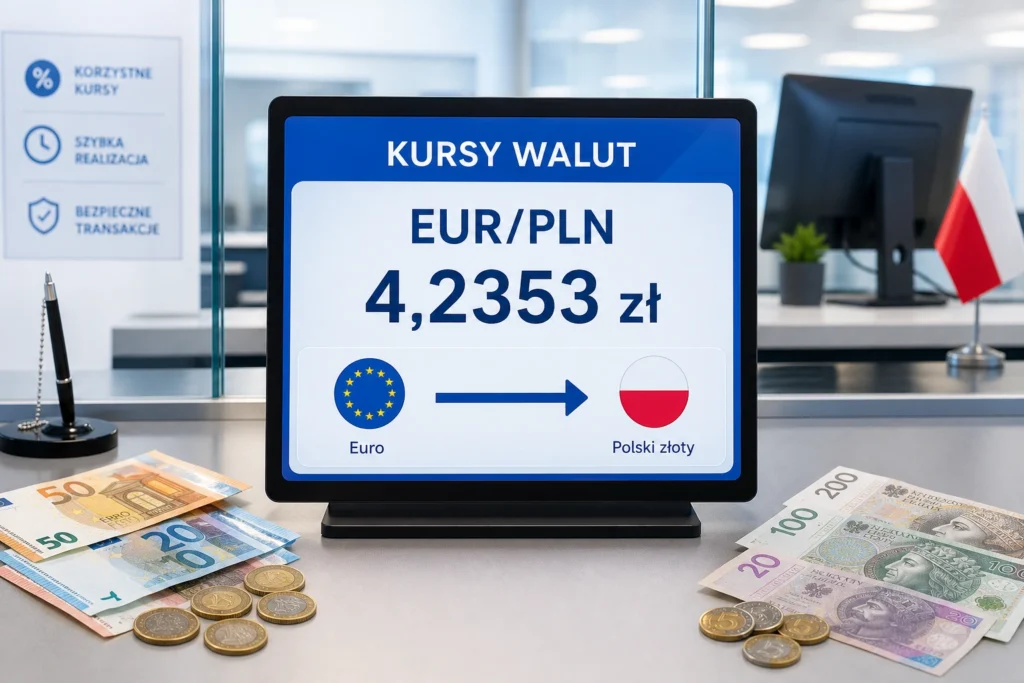
At 9:15, the euro was trading at 4,2353 zł, only slightly above the key support level. Analysts at PKO BP said in the morning that, with elevated risk of escalation in the Persian Gulf region, the zloty may remain under slight pressure, with EUR/PLN moving toward 4,24 to 4,25 and USD/PLN toward 3,66 to 3,68.
The U.S. dollar was trading at 3,6466 zł in the morning, 0,4 grosz more than a day earlier. The Swiss franc was priced at 4,6287 zł, and the British pound at 4,8884 zł. In both cases, the changes were small, showing that the currency market is still reacting cautiously.
Sources
- Current exchange rates: Narodowy Bank Polski (average exchange rates table)